Wednesday, April 27, 2011

Kerala Backwaters

We just returned from a short trip to Kerala, a small state in India's southwest. You may may remember Kerala as the setting of Arundhati Roy's 1998 novel The God of Small Things. Her representation of a place characterized by the ebb and flow of water is spot-on. We explored the "backwaters," a system of inland waterways and brackish-water lakes that goes on for hundreds of miles parallel to the Arabian Sea. There are villages along the banks and seawalls bordering rice paddies. Everything is green and wet. People say that when the monsoon comes about a month from now, the landscape will be even greener and wetter than it is. I can't imagine how that's possible.

We began our trip in Kochi (Cochin), a city of about a million, right on the sea coast. The Portuguese explorer Vasco de Gama landed here in 1498 and claimed the harbor for Portugal. It later fell to the British, who brought tea and cricket. We stayed on an island in the middle of the bay and took a ferry to Fort Cochin, the old town. Here is a video of the ferry. Note the Bollywood music on the PA system.


One of the bigbest tourist attractions in Fort Cochin is the Chinese fishing nets, which are these crazy levering contraptions that are supposedly used to catch fish.


The fishermen explained to me that these days they make more money doing demonstrations for European tourists than from fishing. Apparently the Europeans tip well--he was disappointed with the stack of bills (around $6) that I gave him. Here is a video of the demo.


Later we cruised around the warehouse district looking for a wholesale market for spices. We found only tourist traps and small-time retailers. No one was willing to sell us a kilo of cardamom pods (yes, I am the Scarface of cardamom) for a price we were willing to pay. We later learned that the wholesale market is on the mainland, not in the old town. Anyway, here is a video of the autorickshaw ride. We are completely used to traveling by "auto" at this point, which means we only contemplate death once or twice per ride.


And we met our first female autorickshaw driver (or "rickshaw wala").


Kerala is one of three Indian states ruled by Communist governments (West Bengal and Tripura are the others). We arrived at the end of a weeklong election, and the campaign posters were everywhere. To an American born and raised during the Cold War, the sight of the hammer and sickle on every street corner was startling. Turns out the Communist politicians in Kerala look a little different from Stalin.


Note the Chinese fishing nets in the background of this poster.


Next we went down to Alleppey, a fishing village now home to over 1000 tourist houseboats. Everything we read told us not to book a boat in advance: better to see the vessel first, then negotiate the price. Turns out this was good advice, except on Good Friday. The houseboat terminal was packed with boats when we arrived, but the vast majority of them were out of commission so that the crews could--what? Go to Mass? Re-enact the passion? Kerala has a higher proportion of Christians than most Indian states, but still, Christians make up only 20% of the population. At any rate, it took us a few hours to find a tour operator willing to take our money.

Fortunately, it was worth the wait.


We concluded our trip with a night in Kumarakom, another backwaters village. Our hotel had a fishing pond, where Violet caught several gorgeous sunfish. My camera was out of juice so I couldn't take a photo, but she was beyond delighted. Freaked out is more like it. We used chapati (roti) dough for bait, which explains why the fish were so fat and happy.

Violet also did some pottery.


The best part about Kumarakom was the bird sanctuary next door to our hotel. If you've been wondering where to find the jungle of Mowgli, Baloo, Shere Khan, et al, this is it. Remember that all this is going to be even greener a month from now.


Next weekend we are going to the other end of the subcontinent: Dharamsala, in the Himalayas. This place is crazy, na?

Sunday, April 17, 2011

Medical Tourism

I aimed to avoid the Indian medical system. You can run halfway around the globe to avoid your demons, but they will always come and find you. At first, I reluctantly sought care for some of my pesky health issues. Now I find myself seeking out the care because it's just so damn good, so convenient, and so cheap. Today, medical tourism in India is a $310M industry. In 2 short years, the Indian government predicts it will be a $2B industry. Put another way, you know there are issues with healthcare in the States, when your doctor in the US actually advises you to see specialists while living in a developing country. I thought she was crazy, but actually she was right. India has come to the rescue for the US system's inadequacies.

I was referred to the Rainbow Clinic, less than 5 minutes away from our home. As I pull up to the clinic I see young girls less than 5 years old carrying enormous stacks of firewood and/or babies and men piling bricks to be carried on their heads.


Once inside, I pay Rs 300 ($6) to see a specialist. Did I mention what it took to get an appointment? Just a call the day before (no automated phone tree, no waiting on hold) - the hours are so convenient that I can come after work or on the weekends. Why, pray tell, are all of my doctors in the States working part-time so that they can spend time with their kids? As a result, I receive no continuity of care and have to take off time from work just to see them. My health suffers because whoever is on call has no clue about my medical history and doesn't have time to listen. Shouldn't doctors in the US make themselves available to suit my busy schedule when I'm working 60 hours a week and sacrificing time with my own kid? Which system abides by the Hippocratic Oath?


Now, the Rainbow Clinic may not be much aesthetically, but it has opened up my eyes to the stark problems of the American health system.


In its advertising, the Rainbow Clinic cites a study which named it one of the 4 best OB/GYN/pediatrics clinics in India. Inside, there is a fascinating medical hierarchy reflected in the dress of the staff: Ayah-mahs wear the typical uniform-blue saris (and bring the doctors tea), receptionists wear an aqua one with pretty purple trim. The medical assistants wear green scrubs. Interns and medical residents wear salwar kameezes. The doctors and specialists wear stunning silk saris with gold trim.

Cons
First I'll take you through minor inconveniences of the Indian system, because should you visit India, you'll heed these first. Note that a $2B industry can easily fix the most pressing issues listed below:
  • No rubber gloves (though hands are sanitized) when blood is drawn
  • No bandaids either
  • Ambulances should be avoided, because if you are in critical condition, you will likely expire on the way to the hospital in crazy Indian traffic
  • No trashy magazines provided (I really don't miss them)
  • No toilet paper, and possibly no soap in the bathrooms
  • No emotional fluffiness provided (having a miscarriage? plan to be in the same labor and delivery ward as mothers-to-be and their omnipresent mothers-in-law as they welcome a new life into a country already populated by 1.2B people)
  • No ultrasounds telling you the sex of your baby (that is against the law) and thank goodness because the birthrate of girls is falling annually here (927 girls to every 1,000 boys born in 2001; in 2011 it's 914 girls to every 1,000 boys)
  • You may hear the words "I told you so" by your doctor or "You clearly don't need to work. I advise you to get your priorities in order and quit your job so I can treat you." As long as you can shrug these comments off as proof that your doctors are human (and fallible); they will diagnose you and treat you with more care, attention, and access to cutting edge medicines than they will make available to you in the States
Pros
  • Stellar care - quite simply, smarter doctors who make themselves accessible to you. I kid you not, my specialist gave me her phone number. I called her on a Sunday, she picked up, and answered my question
  • No waiting, no bullshit
  • Tea! The best you ever tasted, always accessible, any time, any place (no matter what condition you have, it's always sweeter with tea)
  • 45 minutes with a specialist costs $6
  • Prescription drugs will cost you another $6 - there's no waiting for them, and you don't even need a prescription (why should the rest of us wait hours at Walgreens to protect that .00001% of the population who may abuse prescription drugs?)
  • Tests that cost you thousands of dollars in the States will cost you $100 and a ride across town. But don't worry about traffic, because the clinics are open on the weekends!
  • Access to your own medical records - you take them with you! No more time on the phone, signing waivers for scans of your own god damned body that you paid thousands of dollars for
  • Next day appointments when it's convenient for you
  • No hassling with insurance companies, because you paid cash!
Now it's true that many people in India can't afford this care, but the good news is many more can today than in previous generations. I think I'll go to the doctor every day between now and the time I return to the States so I can avoid ever going again when I get home.

My Master

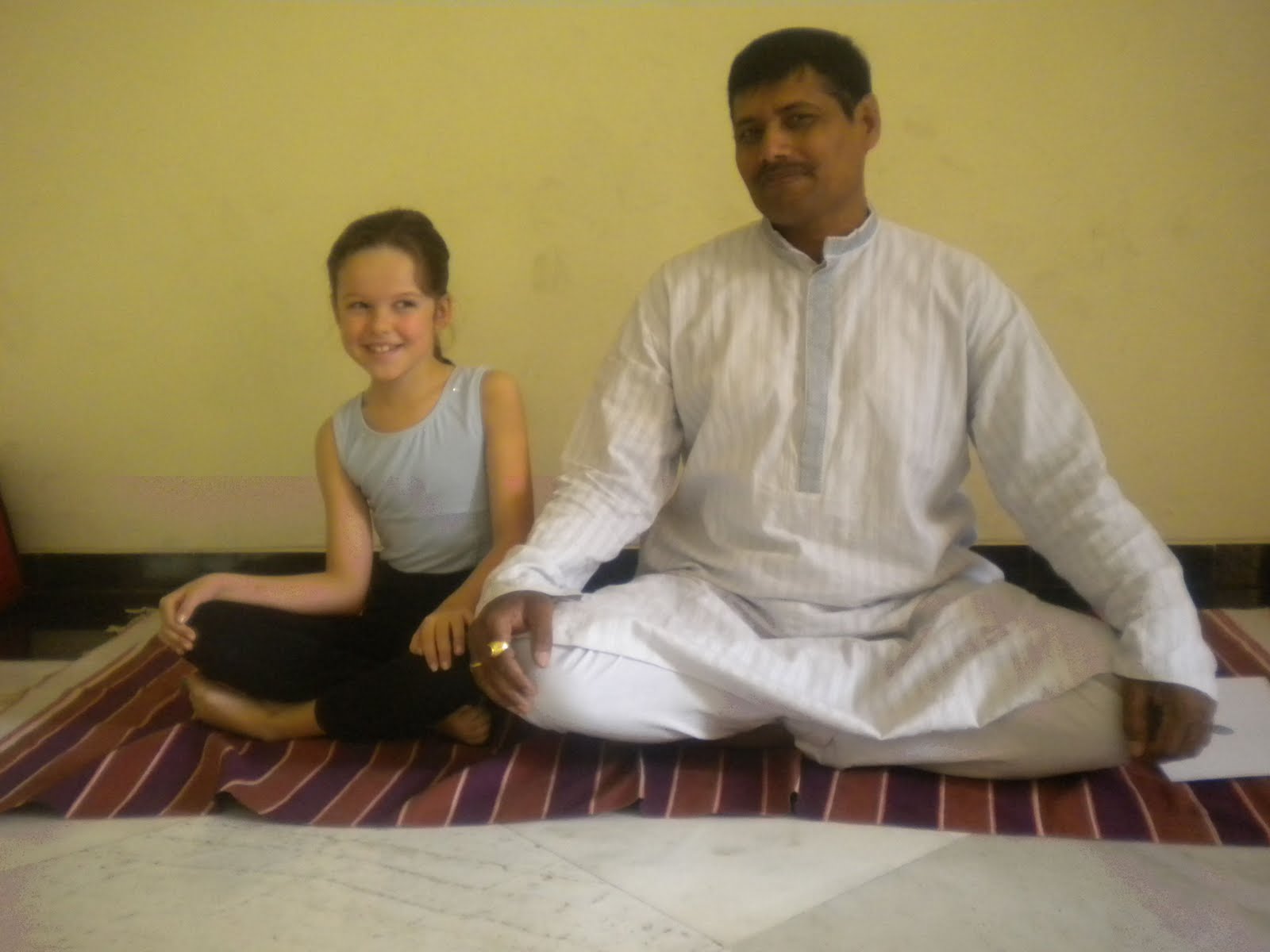
The last thing I expected to find in India was a guru. I try to avoid cliches in my life as I would in my writing, and with a few exceptions (publishing a campus coming-of-age novel; liking baseball; marrying my college sweetheart) I think I have done a decent job. But the guy who teaches yoga every morning in our building's community room was just too real to resist. His name is Guru Navajeevan Viswakarma. He is a fifty year old vegetarian Hindu from Bihar, a predominantly rural state in the north. He moved to Hyderabad half a dozen years ago with his wife and daughter, and now travels around the city's western edge on his motorscooter, teaching yoga wherever he is called. As another famous guru once said, "Where two or more are gathered, there you will find me..." Okay, he will do one-on-one lessons also, but you have to pay more! I have been taking his class for about three months, and on Saturday I finally remembered to bring my camera downstairs. Guruji graciously agreed to sit for a portrait.


We chant a prayer at the beginning of each class. It is in Sanskrit, but the basic idea is, "God, grant us peace, and let us not hate each other." Then we rub our hands together to produce fiction, and we transfer the heat on our eyes, neck, arms, feet, and so forth. Namaskaar, class can now begin.

I tell people that Guruji is both more and less spiritual than any of my previous yoga teachers. He is more, because, well, he is Indian, and he wears a starched white kurta, and he understands the names of the poses. He even pronounces them correctly. (Note to American yogis: in Sanskrit, you don't pronounce the last "a" in "asana.") I also sincerely believe that he channels something, some god-force, when he does his om-chanting. His eyes roll back in his head as the lids remain open, so that you see two little crescents of eye-white. It is spooky, but very spiritual. On the other hand, he takes cell phone calls during class and occasionally slaps a student's errant hand or foot into the proper position. He is somewhat money-grubbing, for a yoga teacher, but that makes sense when you consider that he is making his living teaching these classes (we pay approximately US$2.00 per head per class). I don't think any of my previous yoga teachers made their living solely through yoga. To give you an idea, our last teacher in Menlo Park drove a Bentley--not bought with yoga fees, I assure you.

Because he has trouble with the short "i" sound, he calls me "Neck." Like this: "Neckji! Find your balance! Why you not find your balance before touch your heels?" I doubt he has any formal training in English, and his self-taught dialect contains all the charming malapropisms you'd expect. For example, when we are lying on our backs in savasana ("corpse pose"), he tells us, "lose your back, lose your shoulders, lose your neck, lose your head. Lose your stomach, lose your hip, lose your nezzer regions..." He means "loosen," not "lose." Some of the women in my class have asked him to improve his English, but I hope he never does. I am a fiction writer; characters like Guruji are my bread and butter.

Here are some of my other favorite lines: "Neckji! Look me!" (ie, watch me demonstrate the pose); "Apart your legs!" (slap!) When he wants me to remember to breathe, he approaches me on all fours and starts sniffing like a bloodhound. You have to understand that he is not trying to be funny. This is all deadly serious to him. He also burps and farts without shame, which Violet loves. She and her friend Avisha, whose mother also takes Guruji's class, have created a dance routine where they giggle and recite some of the guru's most famous lines.


A few weeks ago, he approached us after a Saturday morning class. "Jessica!" he called with a blazing grin on his face. "Madam, I want to make more people to this class. I need...marketing!" He asked me to create a poster for him on my computer. So I sat and took down the benefits of his style of yoga. According to him, they include stomach disorders, thyroid problems, constipation, and piles. When I asked if he was sure about these claims, he asked if I had spelled "thyroid" correctly. Then, a few days later he called to check on the status of the poster. "Neck!" said the voice in my cellphone. "Neck, it is your master. Hello!"

Tuesday, April 12, 2011

Special Puja Day

The phone in our apartment rang later than usual last night. The caller did not introduce herself, but I recognized the voice as that of Sandita, a neighbor whose daughters attend Violet's school.

"Hello, Nick, tomorrow is an auspicious day. We are having a puja to honor the goddess by giving gifts and sweets to small girls. Can you bring Violet at 10am?"

How can you say no to that?

So I dragged a terrified Violet ("They're going to make me pray to their God!") to the puja this morning. Sandita and her daughter greeted us at the door and led us immediately into her bedroom to see the "temple." This is small shrine dedicated to several gods, most notably Durga (she rides a lion) and Lakshmi (she rides an owl). You can't see the individual gods in the photo below, but you can see the jasmine garlands and incense.


Sandita gave each girl a dot of vermilion on her forehead (a bindi) and a red string bracelet around her wrist. For months Violet has been curious about these "God strings," because they are the only form of jewelry kids are allowed to wear at school.


Over the next half-hour, the doorbell rang many times and the living room filled with girls of various ages, wearing a variety of traditional costumes. Sandita set them up with plates of puri (a sort of fried airpuff), sauteed black chickpeas, and semolina halwa (sweet grits). Each girl also received a small gift, for example a pack of markers, and a ten-rupee note.


Sandita explained that young girls are believed to be the purest incarnation of the goddess Durga, and therefore it brings blessings upon your house to gather as many girls as you can and pack them full of sweets. I'm paraphrasing horribly, but that's basically the idea.


After the puja, while the girls played in the next room, our host tried to teach me some Hindi phonics. If you ever want to feel tone-deaf, try learning an Indian language. One of the tricks I learned is to hold your palm in front of your mouth when you say, for instance, chhota ("little boy"). If you are pushing air, you have it. I am going to keep trying.


Monday, March 28, 2011

My friend Somu

Our apartment building has maybe fifty flats. Fully three-quarters of them house Indian families who moved here from America. The most common story goes like this: the husband came to the US in his early twenties for graduate school (business or engineering) and ended up staying between six and twelve years, building his career (and salary history) in the land of dollar-denominated wages. When the young man was established in his career (and, often, also after he had become a US citizen), he sent out a marriage beacon. Because the matchmaking network is the only efficient piece of infrastructure in India, a suitable girl was located within a few months, and on one of the young man's measly two-week American vacations, he came home and got married. The wife accompanied him back to the US (for more on this experience from the wife's point of view, read Jhumpa Lahiri's The Namesake), where their children were born. Please note that this is not a generalization; I can name at least three families who fit this description.


Most of these families come to India on temporary assignments with multinational corporations (MNCs). There are a hundred reasons why they do this, but I'll mention some of the most important: living near extended family; exposing their children to their cultural roots; the opportunity "save like a VP" (ie, to draw an American salary but pay Indian living expenses). The catch with an expat assignment is that it is by definition temporary. If you want to stay here longer than your assignment, the MNC will happily "localize" your salary to the prevailing rate, a cut of at least 50%, and probably more. For most of these families, temporary is fine. One family we know is planning to return to the US when their eldest son reaches high school, because they know he will have a better chance of getting into a top American university that way.

Here's where my friend Somu's story leaves the standard script. Somu came to the US in the mid-eighties to pursue a PhD in computer science at Rutgers. Like many young engineers, he could not resist the call of industry and left Rutgers before finishing his dissertation. Over the next two decades he founded a number of companies, including one that provides software to local elections bureaus. He did return home to get married, and his wife grew to love their suburban American life. He told me that by the time his two daughters were born in the mid-2000s, he could have retired. He had paid off his house, and his companies were so well established that he could basically coast for the rest of his life.

But he didn't want to do that. To mark his twenty-second year in the US, he made a list of 22 reasons to leave America. One was that Americans have forgotten how to eat. Any place where they sell ice cream and shrimp by the bucket has a serious problem. A direct quote: "People don't eat out of buckets--animals eat our of buckets." Yes, but most Americans don't know how animals eat. Every Indian knows what a cow is like--how she eats, moves, relieves herself. Even city dwellers see farm animals on a daily basis. In America we think it is civilized to be separated from the beasts of the field. In fact, the separation makes us less civilized. Certainly with respect to our eating habits.

The real reason Somu moved his family back to India is what you might call duty. The Indians call it "dharma," or the proper way to live. Somu has made it his goal in life never to retire, and he has chosen his hometown, Hyderabad, as the venue for his restlessness. He says he could not imagine wasting his talents, his experience, his expertise, and sitting at home all day. On a much smaller scale, he reminds me of Bill Gates, who must have had a similar realization. Like Gates, Somu decided not to retire, only to change venues. Of course, Somu isn't wealthy enough to take on issues like world poverty or polio or malaria, but he has created at least 25 jobs in his hometown--jobs that did not exist when he left India in 1986, and would not exist if he had not returned 22 years later.

Last week I visited his office to give an English lesson to his staff. We spent an hour working on opposite pairs ("Are you fat?" "No, I am thin." / "Are you hot?" "No, I am cold.") and simple conversation skills.


Somu's new company is only a couple of years old, but it is expanding by leaps and
bounds. The focus is transactional mail--brokerage statements, phone bills, and so forth, which is a huge market opportunity in India, where Internet usage is low and "e-bills" are not an option. I get the feeling it's not the technical challenge that gets Somu out of bed every morning. And it is certainly not the money. Instead, it's the feeling that he is doing right by his countrymen and countrywomen. And also, as he is fond of telling me, "India is just more fun."


Thursday, March 17, 2011

Holi

Querido clase,

Hoy fui a un festival de Holi!!! Yo estoy rosado porque poní un polvo en mi cuerpo para Holi!!! A mí me gusta Holi mucho. En Holi hay un tambor y hace musica y todos bailan y ponen polvo en todos. Para Holi tengo que ponerme ropa que no me gusta para que la ropa se ensucia.

Quieres ver mi foto? Estas dos niñas son hermanas y son mis amigas.


En Domingo voy a ir a otra fiesta de Holi. En esa fiesta de Holi vamos a ponernos agua. No aguacates--agua. No polvo--agua. Es muy divertido. También tiramos sempasúchil. Eso es un flor. A mí me gusta Holi. Y tú?

Violeta


Sunday, March 13, 2011

Lassitude:

The way you feel when you wake up feeling anything but refreshed (under a pink mosquito net, under a high velocity ceiling fan).
Sloth caused by 95 degree days, un-airconditioned grocery stores, and poorly behaved Indian children.
Bad attitude caused by any of the following conditions:
-school without recess and kids who don't mind their own business (Violet's words)
-no end to sexual repression and gender discrimination (my words)
-fat men in speedos who try to foil your efforts to get in the pool because you haven't showered and aren't wearing a proper swim cap, (but really it's because you are wearing an immodest one-piece bathing suit that reveals your upper thighs and actually know how to swim) (my words again!)
-trying to find a ride home because the trains have been burned because of political unrest
-trying to procure a Kingfisher beer on a Friday night but good luck because either the restaurant you are in doesn't have a liquor license or there is a city-wide alcohol drought ALL WEEKEND LONG because of political unrest.
-your coconut walla is trying to not charge you 12 Rps. for a coconut, when you know damn well that the going rate is 10 Rps, because that's what you've been paying him all along.

Luckily for us...Tea fights lassitude!